Introducing OpenWorkspace®
Part II
Expanding the Desktop
How the widespread adoption of multiple monitors led to a new interaction model for the desktop.
By the team at OpenWorkspace
September 1, 2026
Overview
Today's desktop operating systems still rely on a graphical interface designed over 50 years ago, with most major advances ending in the early 2000s. Since then, the information landscape has exploded. Users now juggle far more web pages, web apps, and desktop applications than ever before.
To keep up, many turned to multiple monitors, gaining more workspace but adding complexity. Larger single displays simplify setup and aesthetics, but sacrifice usability by removing the spatial separation that separate screens provide, forcing users back to basic window snapping.
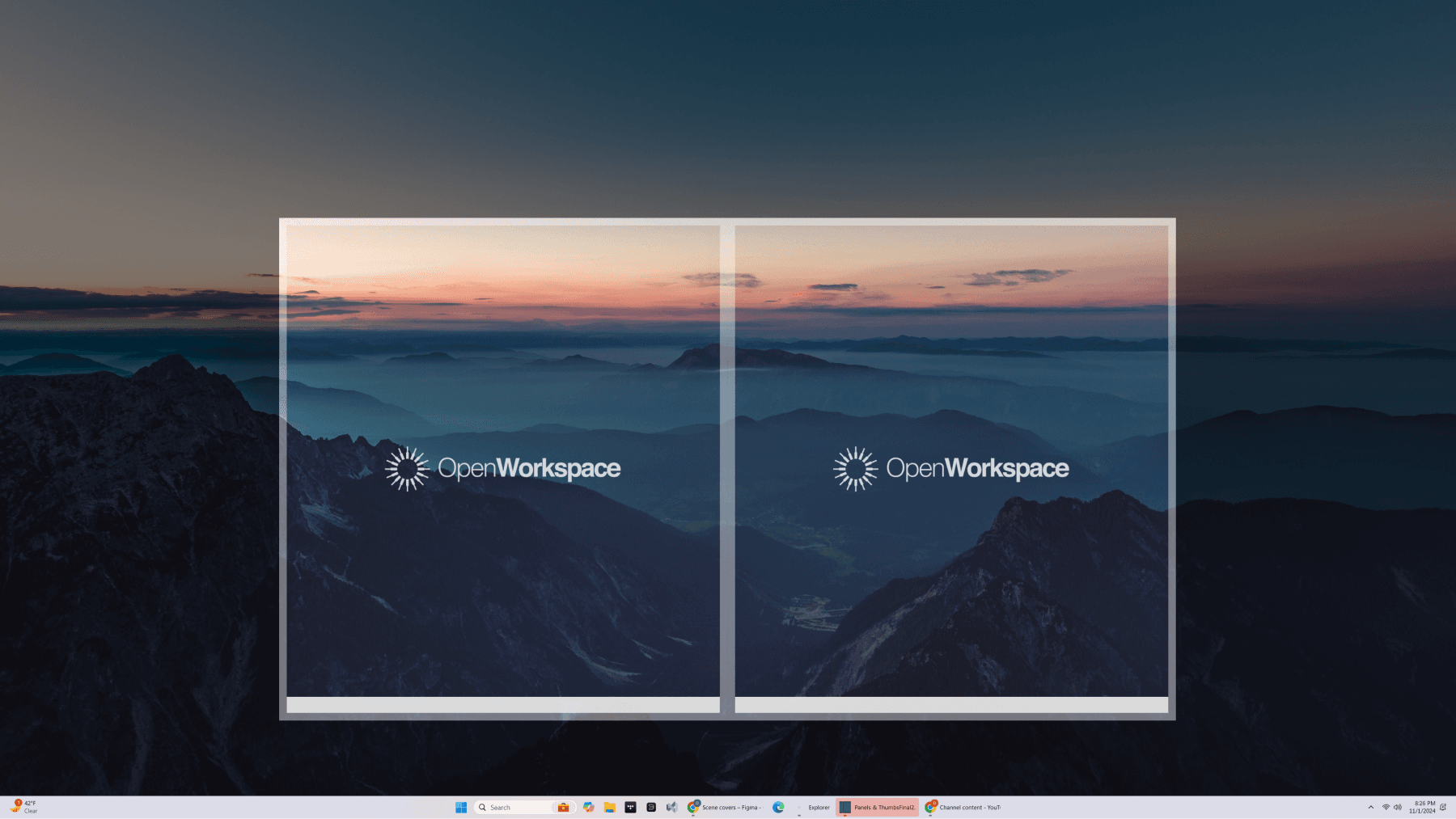
OpenWorkspace addresses this gap with FocalContextual™, its focus + context interaction model for the desktop. Primary work remains in focus while supporting information stays visible in the surrounding context. This approach extends the classic GUI to take full advantage of today's large displays while preserving spatial organization. Optimized for single large monitors and adaptable to multi-monitor setups, OpenWorkspace offers a more natural way to manage modern workloads.
The desktop graphical user interface (GUI) is one of the most significant innovations in computing. By replacing command-line interfaces with intuitive visual elements like icons, windows, and menus, it revolutionized how people interact with computers. Even in the age of the web, smartphones, cloud computing, and AI, the GUI remains as essential to work today as ever: a familiar and universally understood interface.
The fundamental elements of the desktop GUI remain consistent across all major operating systems.
At the heart of this universal interface are three essential elements that shape how over a billion people interact with computers daily:
- The launch bar.
- The desktop icon.
- The overlapping window.
Over the past 15 years, consumer technology has focused on mobile computing, while enterprise tech has prioritized cloud computing. Yet, at the edge of this transformation, a cultural shift has occurred, one where users have taken a greater interest in the desktop experience than they have in decades, fueled by the rise of hybrid and remote work.
With cloud computing came the era of digital transformation, and with it, an explosion of information:
- In 2009, the amount of available digital information was 25,000 times greater than when the Xerox Star introduced the desktop GUI in 1981.
- By 2014, that number had surged to 375,000 times as much.
- Today, workers have access to 8 million times more information than in 1981.
The need for more screen space
As the digital information explosion reshaped work across industries, workers needed a more expansive view of information than ever before. Yet, the desktop remained largely unchanged since the introduction of the Taskbar and Dock, offering no built-in solution for managing the increasing complexity of digital workflows.
With no better alternative, users resorted to a practical, quick-and-dirty fix: spanning the desktop across multiple monitors. This workaround became the default method for improving productivity and workflow efficiency, compensating for the desktop's failure to evolve alongside the growing information demands of modern work.
FocalContextual is a window-management method with explicit Focal Panels and a surrounding Contextual Region. A visually similar arrangement of ordinary windows does not by itself reproduce those spatial roles or transitions. See FocalContextual vs. Tiling for the direct comparison.
FROM RESEARCH TO PRODUCT
Keep everything in view instead of continuously searching for buried context.
14 days · No credit card required